Requiem For Gaza
Book Review by David Brooks Deaton published on 27/05/2026 in Counter Currents
Francesca Albanese
When the World Sleeps: Stories, Words, and Wounds of Palestine
New York: Other Press, 2025
English translation by Gregory Conti, 2026
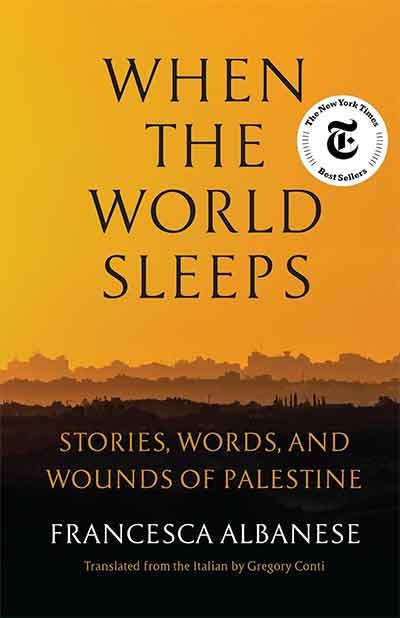
The purpose of this article is to let the world know such a book has been written, by no less a person than Francesca Albanese, United Nations Special Rapporteur on the Occupied Palestinian Territory. “Rapporteur” is a fancy word for reporter.
Since October 9, 2023, Ms. Albanese has had much to report. That was when the government of Israel declared a total blockade — of food, water, medicine, electricity, and anything else — on the people of Gaza, in response to an alleged military invasion two days earlier. From that moment on, Israel decreed a genocide – that crime of all crimes — which continues to this day. That half of the people in Gaza are female and more than half are under 18 years of age is deemed irrelevant. Has the modern world seen such breathtakingly vicious, indiscriminate death and destruction, visited upon a defenceless people?
In a work of less than 250 pages, Ms. Albanese tries to make sense of how things stand in the Holy Land by a an overview of recent history, international law, and memorable profile journalism. Each chapter poses a question such as “What are the consequences of the occupation?” and “How to calculate the conditions that lead to a destruction of a people?” — and answers them to varying degrees of success by talking with a sympathetic witness. It would have been interesting to hear a confirmed Zionist answer the question, “How do you justify a prolonged genocide?” but no one of that persuasion was willing to talk. Indeed no UN Special Rapporteur has been allowed so much as to visit Palestine since 2008.
Perhaps the most powerful chapter (“What is childhood in Palestine?”) begins with the harrowing story of Hind Rajab, a six-year-old Palestinian girl, who was the sole survivor of an Israeli army attack on the family car, whose heart-rending phone call to the Red Crescent was recorded and later went viral on the internet. Emergency workers who came to rescue her were in turn gunned down, as was Hind herself, who died all alone for no other crime than that of being Palestinian. Her life and early death has come to exemplify the tragedy of Palestine.
Albanese writes:
Hind was killed more than three months after October 7th, when Israel had already killed ten thousand children. How is it possible to tolerate all this killing? And how is it possible that still today — as I am completing the revision of this book at the end of August 2025 — when the number of dead children has come to exceed twenty thousand, of whom more than one thousand were les than one year old, that impunity continues to reign and the death machine set in motion by Israel has not stopped?
While Hind Rajab’s murder has become an (in)famous case, Albanese went to great lengths to learn about the crushed and haunted lives of other children in the West Bank and Gaza. They related their experiences to her via Zoom when electricity was available.
I had already collected data on wars, attacks, the destruction of houses, hospitals, schools, evictions, killings, arrests, and so I wanted them above all to talk about their lives…. [T]owards the end, after we had gotten to know each other for a while, I felt ready to ask, “Is there anything that scares you?” Inevitably, everyone talked about death. The greatest fear of these children was dying or losing their parents. Second on the list: being arrested; third “that they’ll knock down my house.” These are the most frequent fears of Palestinian children. This is how they grow up. That alone seems to me to be an unfathomable brutality.
The brutality doesn’t end there, of course. In recent months there have been reports almost to defy the imagination: systemic mass rapes in prison, sometimes involving dogs trained for that purpose. There seems to be no end to Israel’s vindictive depravity. Whoever heard before of a nation insisting on “the right to rape”? Israel now proudly dons the mantle of Sodom. From the glut of daily atrocities, some of them proudly recorded by Israeli soldiers, it’s hard not to conclude that those following a rabid, racist, supremacist ideology have descended into full-blown psychopathy. How else can one understand such behaviour?
In the end, though, Albanese’s book is less of an indictment of a pathological nation than the passivity of the so-called international community, which meekly allows Israeli genocide to continue under its eyes. Her indictment could be reduced to the opening page of her book, compiled from excerpts of a speech she gave to the UN General Assembly after one year of Israeli mass murder. “I’m really upset,” she says. “I’m upset at people’s indifference.” She remonstrates: “Those of you who have not uttered a word about what is happening in Gaza demonstrate that empathy has evaporated from this room.”
Albanese continues this theme in her book: “I will say it bluntly: To deny the seriousness of these actions is to close our eyes to a crime in progress. A crime that would call for the urgent mobilization of the international community, which unfortunately has not taken place to a sufficient degree, because today as yesterday, before a genocide can be stopped, it must be seen.”
Ah, but it has been seen! And documented. And adjudicated — by not one, but two international courts of law — the International Court of Justice (ICJ) and the International Criminal Court (ICC) — and a certain UN Rapporteur in one meticulous report after another. No one can say they don’t know about the genocide in Gaza, not when it’s been live-streamed for nigh on three years. The problem, as Albanese says at the outset, is that not enough people (and very few governments) seem to care.
Albanese points to the happy example of South Africa which some decades ago was encouraged or compelled to abandon its racist policies by the world’s collective concern. For this reader, the most surprising and inspiring of Albanese’s stories was how the world-wide South African BDS movement came to be.
It began in Ireland in 1984, when Mary Manning, a twenty-one year-old supermarket cashier, in accordance with the directives of her union, refused to handle grapefruit from South Africa. When Manning and her union representative, Karen Gearon, continued to refuse to handle any South African products, calling on other workers to do the same, they were suspended and started a strike that was joined by eight other colleagues.
The strike lasted almost three years, until April 1987, and set off a chain reaction that led Ireland to become the first Western country to impose a total ban on the import of South African goods, thanks to public pressure aroused by the courageous refusal of Mary and her colleagues.
Ah, the power of one, or two, or eight — anyway, not many! Surely this tale must be some Hollywood confection, but it really did happen this way. One small group of activists got their own government to act eventually, in such a way as to cause a world-wide ripple effect. Under the pressure of BDS, South Africa was moved to become apartheid-free.
Albanese suggests the same course of treatment in her address to the UN General Assembly: “[You] could stop all this. Really, at the stroke of a pen.” “At the stroke of a pen”?! Seriously? But who knows better than this UN official how the world really works? Her prescription: “There is no other way than by imposing sanctions on Israel and revising its diplomatic, economic, political, military, and strategic ties you have with it.” In other words, let all the nations of the world treat Israel as the pariah state it has surely become.
Albanese reminds her audience, “At first, many Western governments resisted both the condemnation and the idea of accountability, until they found themselves practically forced to recognize that they could not oppose a global campaign of support for the anti-apartheid movement. In the end, they had to give in to a reality they could no longer ignore.”
So why does the world continue to ignore the even worse plight of Palestine, especially those living (and dying) in Gaza? That is not to overlook the plucky BDS Palestine solidarity campaign of many years’ standing, but even now governments aren’t keen to take up this cause. Behold the terrible judgment delivered by this world-renowned jurist: “Israel is now committing genocide with the awareness and approval of the established system of power.”
How can this be? Albanese offers two perturbing reasons. First, intimidation by Israel. It should be noted that back in 1984 Irish cashier Mary Manning had the full support of her trade union. In 2026 it would be a brave union indeed willing to risk the wrath of the Zionist lobby, which has kowtowed governments the world over, even in getting them to pass legislation that criminalizes criticism of the Jewish state. For refusing to handle Israeli produce nowadays, Mary Manning might very well be imprisoned on charges of “anti-Semitism,” a crime less forgivable to these zealots than mass murder.
The other reason for the world’s reticence is even more chilling — apathy, a moribund condition for which there is no cure. Have times changed so much? Has the world drifted into a fentanyl freeze? Albanese’s frustration is palpable: “What can we do to stop all of this? How long will it go on while the world seems to be sleeping a stone cold sleep and cannot keep its eyes open in the face of this wound that is as large as an entire people, this wound that no one seems to want to soothe or heal?”
It isn’t for lack of trying by Francesca Albanese, who has surely written truth to power. Her heartfelt book is no stupefying UN report on human rights abuses, but a resounding cri de coeur: O humanity! Where is the outrage? Where’s the grief?
It’s thought that as many as one million people have died already in Gaza. Those still alive suffer from a never-ending litany of horrors: bombed out of their homes, exposed to the elements, packed into ever closer quarters, asphyxiating in toxic dust and the stench of death, consumed by hunger and thirst, wasted by skin diseases, eaten alive by rats, mice, and insects, stalked by ever-buzzing drones, mocked by global insouciance, and taunted by fraudulent humanitarian relief under a non-existent “ceasefire.” Abandon all hope, ye who live there. Gaza has become Hell on earth.
Israel’s Genocider-In-Chief, Benjamin Netanyahu, knows there is no coming back from such evil, now reaching metaphysical proportions. He and his tribe will press on, counting on the world’s cowardice, indifference, whatever it is, that keeps international institutions (including the UN) quiet and compliant. With no meaningful opposition, King Bibi has resolved to wage war on “Amalek” — the Indigenous people of Palestine — until all have been expelled or exterminated. Nor will he stop there. As indicated in his “Greater Israel Project” and demonstrated by recurrent attacks on Iran, he intends to destroy or conquer the entire Middle East. Israel Uber Alles!
Albanese warns: “It is while the world sleeps that monsters are generated.” But let it be noted these monsters have names and addresses. Even now they can be brought to justice (preferably at the Hague) to answer for their crimes. Otherwise Gaza will be known as the place where international humanitarian law went to die. Judging by recent American and Israeli military attacks all across the region, it has been replaced by the law of the jungle — or in human terms, “Do as thou wilt.” Empathy has yielded to savagery, of an increasingly sadistic nature. If the world’s representatives accept the new status quo, let them be asked: And how much longer is the world going last?
Albanese is somewhat more sanguine, so let the last word be hers:
I fear what might happen in Palestine if the plan of the current Israeli government, supported by the Trump administration, were to be effectively carried out. Forty years from now, someone may be in a place once known as Palestine, but in a university lecture hall named after Donald Trump, offering tribute “to the Palestinians, the ancient inhabitants of the land,” when all that remains of Palestine will be ruins.
This beautifully written, powerfully argued testimony by Francesca Albanese will appeal to all who value law, love, language — and rail at the greatest moral calamity of our age.
May her words and stories help heal the wounds of Palestine.